
Albany has always been Albany. Smoke-filled backrooms that govern at a distance, dictating policy to the country’s largest city while rarely interrogating its own condition. A place of power, not performance; policy, not place.
But that may be changing. Thanks to a distinct shift in approach from Governor Kathy Hochul, Albany is suddenly being treated not just as a seat of government, but as a city worth investing in. And in doing so, the State may be quietly launching a capital rebuild movement with implications far beyond New York.
Let’s get into it.
How Did the Capitol End Up There?
Albany is located on the Hudson River, about a 3.5 hour drive north of New York City. This location made it strategically valuable for both trade and the military in the 17th and 18th centuries. The city originally served as an outpost for fur trading by the Dutch West India Company in Manhattan. Fun fact: the city charter for Albany was established in 1686 and still governs the city, which makes it the oldest city charter still used in the United States.
Albany became the center for planning hijinks leading up to the French and Indian War, including the 1754 Albany Congress where Ben Franklin laid out his plan to unify the colonies under one large red, white, and blue umbrella. New York was declared independent in 1776 and the first legislature met all across the state, bouncing around White Plains, Kingston, Poughkeepsie, and Albany and eventually settling in New York City, which also was the country’s capital city during this time.
New York City would eventually lose both of these statuses due to residents wanting geographic balance. Upstate New Yorkers got frustrated with the commute to NYC and Governor George Clinton (our most Funkadelic governor) made the push for Albany to become the capital in 1797. However, the bill that authorized moving the capital to Albany didn’t specify Albany as the official recognized capital. This wasn’t rectified until 1971 when Governor Nelson Rockefeller signed a bill officially declaring Albany the capital of New York state.
The Arc
There are two eras of Albany - before Empire Plaza was constructed, and after it.
Empire State Plaza is a one-of-a-kind brutalist government complex. The first time I saw it, I was riding in the backseat with a group of other consultants when it came into view. I immediately told them to pull over so I could get out. The ability to share Empire State Plaza with people who have never seen it before is probably 17 percent of the reason I started Capitol Rebuild.
It is GLORIOUS. Empire Plaza screams “Government Happens Here”.
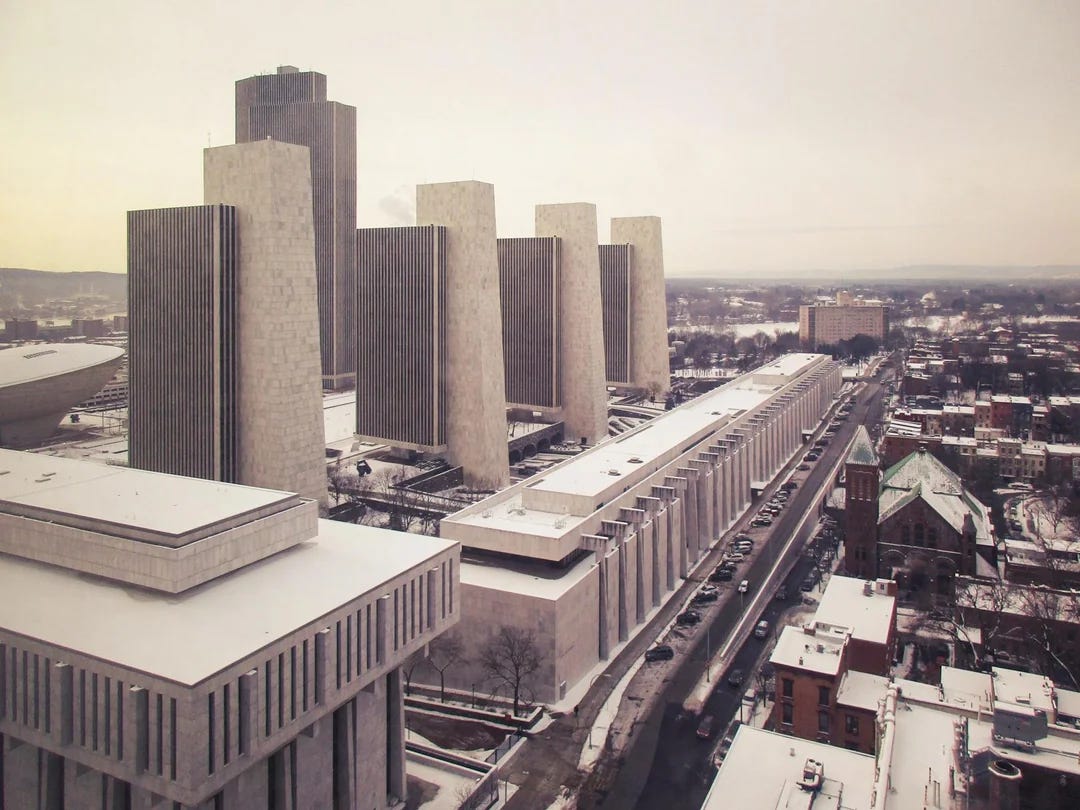
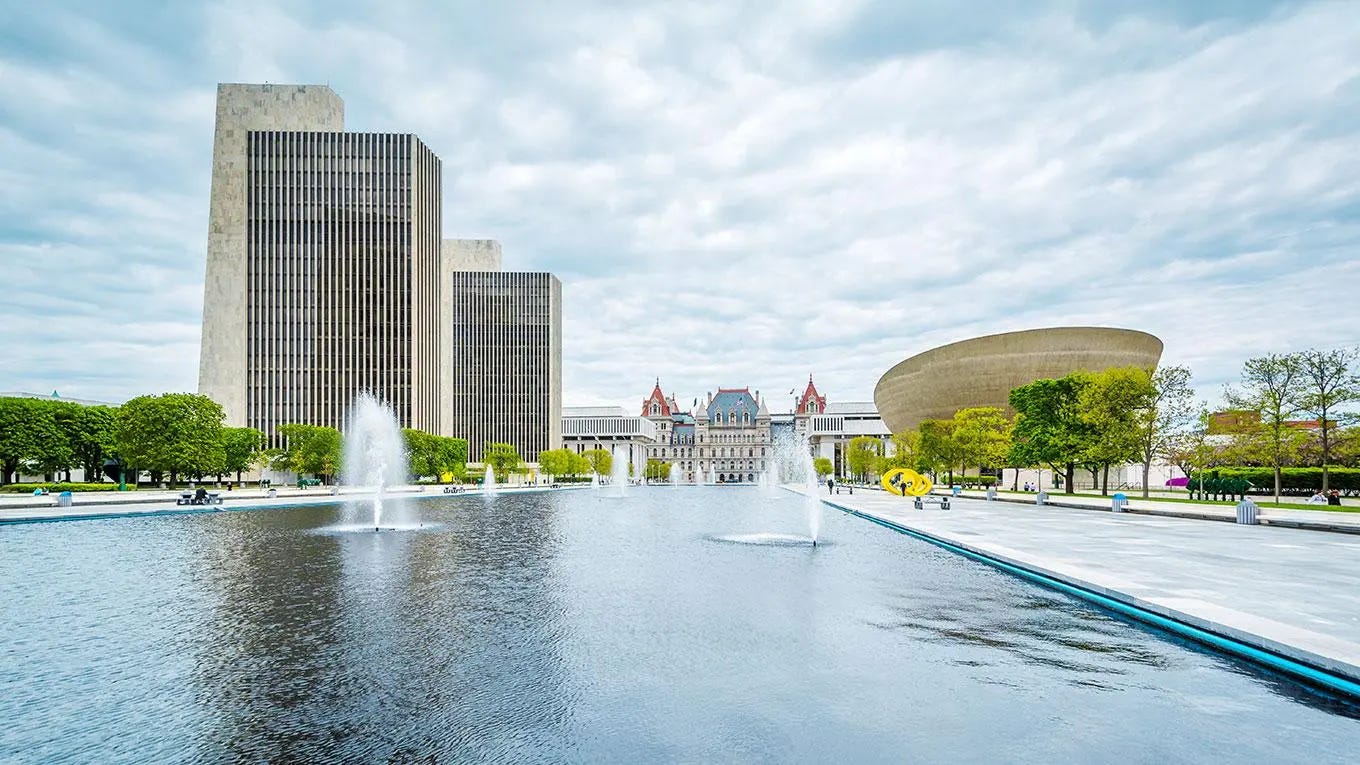
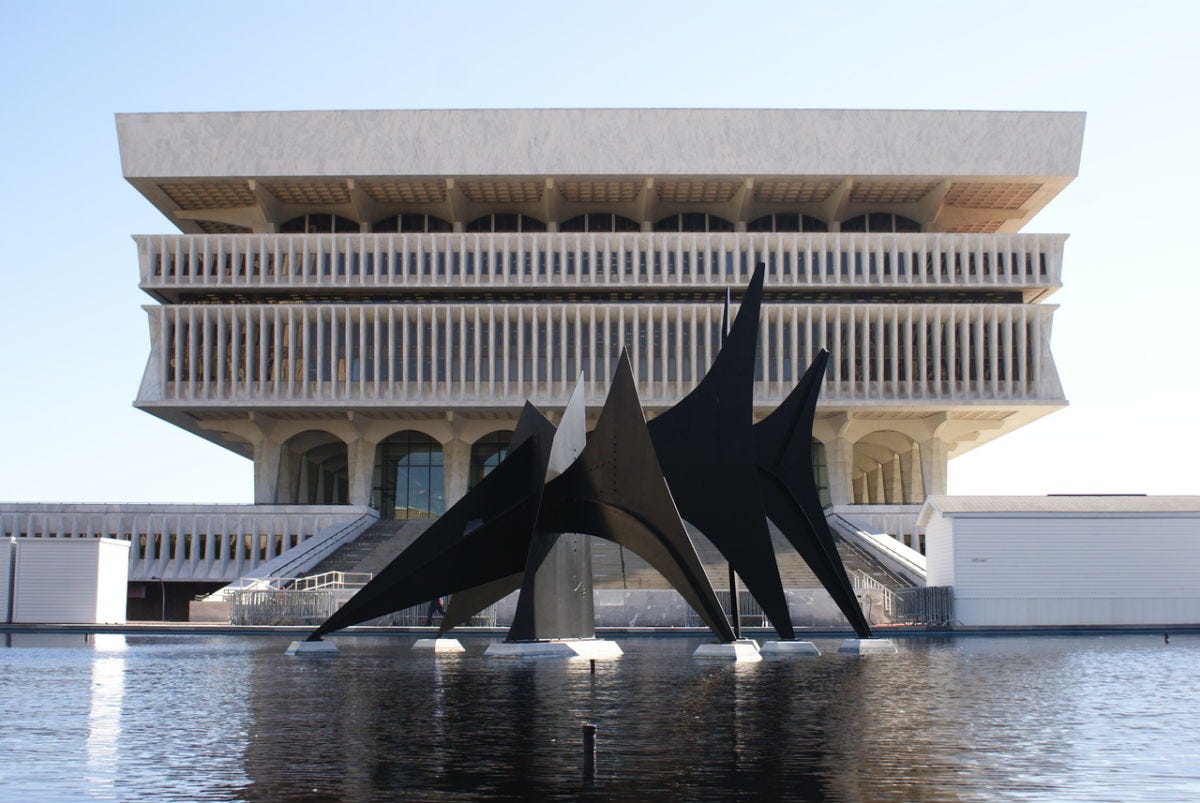
Empire State Plaza was conceived by Governor Nelson Rockefeller who was “inspired” by the reaction he got when he toured the future Queen of the Netherlands through Downtown. Basically, she did everything put hold her nose and wave her hand in front of it while seeing what Albany had to offer. This burned a hole of embarassment into Rockefeller’s soul.
His response was not subtle. He resolved that no New York governor would ever suffer the embarrassment that he did in front of a future European monarch when showing the city off. The solution: spend a truly staggering amount of public money to build a capital complex that would project power, permanence, and seriousness on a global stage.
The architect of Empire State Plaza was Wallace K. Harrison, who worked on Rockefeller Center, the United Nations headquarters, and Lincoln Center in New York. Harrison’s vision was clear: use architecture to demonstrate authority at an almost imperial scale, balanced by vast open space. The result blended European palace complexes with the National Mall, filtered through the clean lines and confidence of mid-century modernism.
There are seven buildings that make up Empire State Plaza (the Capitol building was constructed before Empire State Plaza but serves as the northern anchor):
Agency Buildings 1–4: Four nearly identical 23-story office towers clad in Vermont marble, lined in a row along the Plaza’s west side. They house most of state agency offices and frame the complex’s long reflecting pool. Their repetition was meant to symbolize bureaucratic order.
Corning Tower: Corning Towner is the tallest building in New York outside of Manhattan and was named for long-time Albany mayor Erastus Corning II. It has a futuristic, almost spaceship-like presence on the skyline. The 42nd-floor observation deck provides amazing views of the region.
The Egg: No government complex is complete without a performing arts center that looks like an egg balancing on a pedestal. It took twelve years to build because its concrete shell had to be poured continuously. Sure, maybe aliens will come out of it one day. Until that point, it will just the the Egg.
Cultural Education Center: At the southern end, this broad, block-like structure houses the New York State Museum, Library, and Archives. I
The Swan Street Building: Also popularly known as “the largest marble covered DMV building in the world”.
Did everyone love it? No. But it was a huge swing to define Albany and the regalness of the state capital.
Now, is there negative history associated with Empire State Plaza? Of course there is, this is 20th centurty America we are talking about. Governor Rockefeller did what government did so well in the mid-20th century when they wanted to build something…he displaced 7,000 mainly low income residents so he could build what he thought should go there. Tragic but definitely not surprising.
Empire State Plaza is an architectural wonder and an inspiring symbol of 20th-century ambition that reshaped a city in service of an idea of grandeur. But it is also impossible to separate the glory from the cost and what it took to build.
Making of the Mall Documentary
Empire State Plaza at 50 Video
My Experiences with Albany
The first time I was there was around 2012 for a project interview. I almost fell over I was so gobsmacked by Empire State Plaza. I’ve driven through multiple times since then to stop and grab pictures or get something to eat. I haven’t really experienced the city beyond nerd capital boy stanning and eating at few cool old school Albany restaurants.
What’s Working
THEY ARE DOING THE THING. I repeat. THEY ARE DOING THE THING.
Governor Hochul allocated $400 Million (!) in the State FY26 budget for the Championing Albany’s Potential (CAP) Initiative. Let me write that number entirely out: $400,000,000.00. That is a lot of zeroes.
Direct from the Empire State Development website, “Yet a lack of vibrancy in the city’s core, has led to perceived public safety concerns, making it difficult to retain and attract city-center businesses and residents. Albany’s challenges are compounded by its tax landscape, where 60% of property is tax-exempt, straining municipal resources and limiting the city’s ability to invest in critical infrastructure and services.
This investment includes $200 million* to make real investments into tangible strategies and projects to revitalize Albany’s core downtown and adjacent neighborhoods within a mile of the State Capitol, such as:
Targeted strategies that address public safety and quality of life
Revitalizing vacant or dated anchor institutions
Reinvigorating commercial corridors
Repurposing vacant and underutilized commercial buildings for housing and other new uses
Leveraging open spaces and key public assets
Coordinating with ongoing planning efforts related to the redevelopment of I-787 and the Livingston Avenue rail bridge
Creating new reasons to work, visit, or live in downtown Albany.”
The State of New York is going to invest $200M into improving Albany so it’s more than just a seat of government. I still cannot get over this.
The consultant on the project provided an update for the public in November and you can review the boards here. Quick summary is that people are engaging with the project (700 workshop participants), there is a big focus on creating new housing opportunities, leveraging the Hudson River and the arts, and focusing on policies to make it easier to build housing.
This will be the case study for whether or not I’m wasting my time writing this blog.
*The other $200 Million is allocated to New York State Museum ($150M), Empire State Plaza upgrades ($25M), and lining consultant pockets to study the future of I-787 ($25M).
What’s Not Working
Potholes
No one gets in to government because they dream of filling potholes. But it’s a municipal issue that (1) literally costs residents extra money if the city doesn’t do a good job (2) sticks in the minds of residents, particularly when they compare the place they live to others. So when the mayor-elect ticks off Albany’s biggest issues and potholes is first, before public safety, and before housing, you know Albany has a pothole problem. And if you have a pothole problem, you likely have an overall governmental services delivery problem. When the fundamentals of government don’t work, residents question whether government can handle the harder, more complex challenges.
It’s a Ghost Town at 5:01 PM
Like so many capitals, Albany feels deserted the minute everyone is done with work for the day. When the government workforce goes home for the day, so does the energy of of the city’s core.
There are only so many breakfast/lunch only restaurants that a state government workforce can sustain and definitely not enough to fill all of the retail space in Albany. More people are needed during more hours of the day to build a sustainable commercial environment. The result is a fragile commercial environment: vacant storefronts, short operating hours, and a downtown that feels transactional rather than authentic.
This is a structural problem. Until more people live downtown and more reasons exist to stay after work, the city will continue to struggle to create the kind of continuous street life that defines successful cities.
Streetscapes Have Seen Better Days
Albany has good bones, but too often the public realm works against itself. Sidewalks are uneven. Lighting is inconsistent. Landscaping is sparse or poorly maintained. Together, these details shape how people experience downtown far more than any marketing campaign or master plan. When walking feels uncomfortable or uninviting, people don’t linger, and when people don’t linger, perceptions of safety decline regardless of actual crime data. Aging and underdeveloped streetscapes reinforce the sense that downtown is tired, even where buildings and institutions remain strong.
Capitol Persona
Dorcey Applyrs
When I think of Albany government, I think of a bunch of old white men sitting in the back of a smoke-filled bar making decisions that impact the entirety of the city and the state.
Albany’s mayor-elect, Dorcey Applyrs, represents the antithesis of that.
Unlike the high profile mayoral election in New York’s largest city, Albany’s 2025 election wasn’t about a new vision for the city or promises to make drastic changes. It reflected a demand for voters for government to be competent, empathetic, and follow through on promises. Mayor-elect Applyrs ran a campaign about how government shows up in people’s lives and how to make it better. And that matters in a place like Albany.
Mayor-elect Applyrs comes to City Hall with a background rooted in public service, community engagement, and legislative experience, not machine politics or entrenched patronage. She has consistently framed leadership as problem-solving. In a city where residents often feel talked at rather than worked with, that shift in tone is meaningful.
What makes her a breath of fresh air is that she doesn’t pretend Albany’s problems are mysterious. Things like Potholes, basic services, public safety perception, downtown inertia aren’t political challenges…they are execution challenges puzzles. Applyrs has spoken directly to that reality, emphasizing management, coordination, and accountability over grandstanding.
Just as importantly, she reflects a generational and cultural shift in Albany’s leadership. Her election signals a city ready to move beyond the assumption that being the state capital is enough. She has framed the work ahead as earning trust back, block by block, street by street.
I can’t hide it, I love this type of Mayor.
Capitol Score
Capitol Score is my subjective ranking (using a 10 point scale) on how the city stacks up with regards to place, innovation, arts & culture, and overall livability. A perfect score isn’t the goal, improvement is.
Albany’s Capitol Score is 5.8
Albany has a Capitol Score Potential of 7.5
Three Wishes from the Policy Genie
Just a quick note here. This is just me throwing ideas on the wall based on my limited knowledge of what’s happening. There are likely many many things that need improvement and the folks on the ground will always know more.
Spend the money correctly
Though the genie gives me three wishes for each city, I’d probably use the other two just to make sure this one comes true.
New York State has handed Albany a rare opportunity: $200 million to implement a downtown strategy. That kind of moolah doesn’t come around often, and it almost certainly won’t come around again. The margin for error is slim.
This money can’t be treated as a grant program or a political compromise. It needs to function like patient but demanding capital. Every project funded should clear a high bar: clear return on investment, clear sequencing logic, and a clear path to unlocking additional private investment. If a project doesn’t make the next project more likely, it shouldn’t move forward.
Albany’s challenges are not rooted in a lack of ideas or ambition. They stem from fundamentals that haven’t kept pace, including maintenance, street life, basic experience, and land use mix. Until those are fixed, there is no point in talking about larger visions and transformational projects
That means funding a lot of unsexy projects first: streets, lighting, policy, basic infrastructure, and regulatory cleanup. These aren’t ribbon-cutting projects, but they are the ones that make the exciting projects inevitable later. The pressure is on consultants, city leadership, and the broader civic community to show discipline. Get this wrong, and the city won’t get another swing.
Build a data-driven pothole prediction model
When I worked in the Mayor’s Office in late 2010’s, there were a slew of companies pitching software that identified potholes using video from city fleet vehicles and basic machine learning. Today, Albany could go much further. Combine that visual data with resurfacing history, traffic volumes, weather patterns, construction schedules, and utility work and you can build a predictive model that flags where potholes are likely to form before residents hit them.
This would not only get ahead of fixing roads, but address trust issues between Albany’s government and its constituents. A program like this shows residents that the city is ahead of problems instead of chasing them.
Someone should take this idea and run with it (and just give me some founders equity for giving you the idea).
Get businesses focused on Downtown
Albany cannot revitalize downtown on public-sector energy alone. The Center for Economic Growth (CEG) has been remarkably effective in recent years, particularly in semiconductors and advanced manufacturing. That work matters. But downtown Albany has largely been outside its frame and that’s a missed opportunity.
Downtown needs a stronger private-sector gravity. CEG has the relationships, credibility, and deal-making capacity to help make that happen if downtown becomes a strategic priority rather than a side note. Bringing CEG’s resources to bear downtown wouldn’t replace city leadership, it would complement it. It would help shift downtown from a government-dependent district to a more balanced economic ecosystem, where private employers help anchor activity beyond 5:00 p.m.
What’s Happening in Albany?
Pothole problems frustrate Albany residents
“If I was a police officer, I wouldn’t be able to tell who was driving intoxicated or who was just trying to swerve from the potholes”.
Dorcey Applyrs talks historic win, youth violence, and how she plans to turn Albany around
Albany Mayor-Elect Dorcey Applyrs breaks down her Housing Audit as she prepares for office
I’m a total fanboy at this point.
Can $400 Million Rescue New York’s Run-Down Capital City?
Kind of a harsh headline.
Final Thoughts
I don’t think it’s an understatement to say this is the most exciting time in Albany in decades. You have a new Mayor who is focused on making the city work again. You have a Governor who wants to lean in to make Albany more than just a place for field trips. You have $200M of capital to invest into the city.
However, none of this guarantees success. Its going to take smart planning, disciplined decision making, and a commitment to implementation to make it all work.
But if it works, and god do I hope it works, it should be the model for the majority of capital cities in this country.
Good luck Albany. We are rooting for you.
Capitol Rankings
Capitol score (Capitol potential)
Phoenix, 7.9 (8.4)
Indianapolis, 7.4 (9.7)
Santa Fe, 6.9 (8.5)
Des Moines, 6.7 (8.2)
Montpelier, 6.1 (6.3)
Oklahoma City, 6.0 (8.0)
Albany, 5.8 (7.5)
Olympia, 5.6 (6.7)
Little Rock, 4.9 (7.4)
Trenton, 4.3 (6.8)
Harrisburg, 4.3 (6.1)
Next up, we put on our parkas and make a visit to Juneau.
This article comes at the perfect time, and you've really nailed how Albany is evolving, making me think that perhaps this isn't just a capital rebuild but rather a critical 'system upgrade' for urban governance, a kind of essebtial optimization for cities balancing history with modern demands.